The Money You're Leaving on Booking.com's Table: A Commission Calculation for Your Hotel

Gustavo Marval
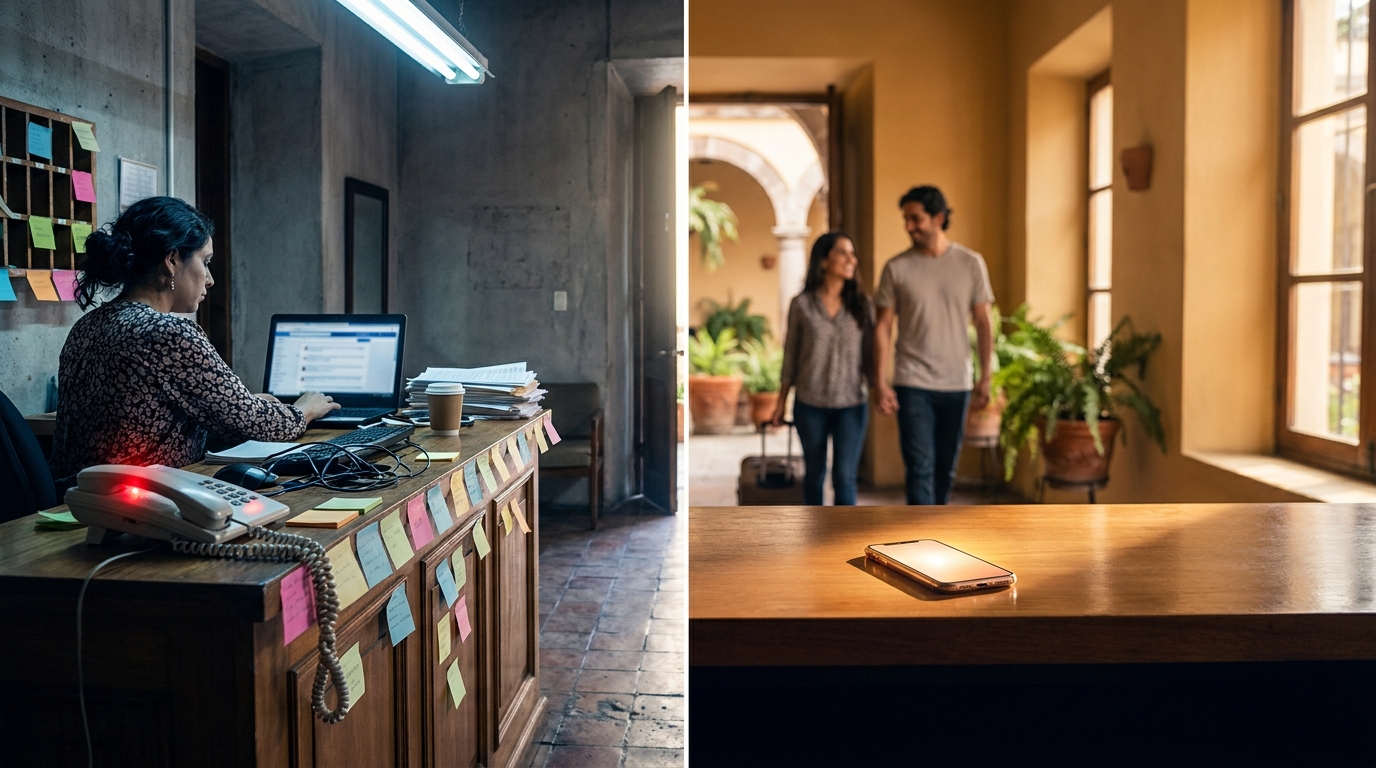
You look at the Booking.com dashboard: $12,000 in gross bookings for your hotel. A good month. Then, you check your bank account and see the final settlement. $2,160 is missing.
That money didn't just evaporate. It's the cost of a system we've normalized. It's the price of believing there's no real alternative to close commission-free direct bookings at scale.
That figure, over two thousand dollars, is the salary of a front desk manager you don't have. It's the air conditioner upgrade you keep postponing. It's the margin that defines your profitability.
The problem isn't the 18% commission the OTA charges. The problem is thinking of it as a fixed cost, an unavoidable tax on visibility. It isn't.
It's the toll you pay for not having the infrastructure to capitalize on the demand the OTA itself generates. The guest discovers you on Booking.com, but then searches for you on Google. They land on your website, see the WhatsApp icon, and message you. And that's where the system breaks down.
The Salary You Pay the OTA
Let's do the math. A 25-room boutique hotel with an average occupancy of 70% and an average daily rate of $120 generates about $63,000 per month.
If 50% of your bookings come from an OTA with an 18% commission, you're paying $5,670 monthly. That's over $68,000 a year. This isn't a marketing expense; it's a ghost salary that feeds someone else's ecosystem, not yours.
This number is your highest customer acquisition cost (CAC). The challenge isn't to get it to zero overnight, but to understand that every booking you shift to your direct channel directly impacts your net profit.
Turning this cost into revenue requires a mindset shift. You must see your WhatsApp not as a customer service channel, but as the core of your hotel WhatsApp direct bookings strategy.
The OTA is a Billboard, Not Your Sales Team
The main argument to justify the commission is "visibility." This is partially true. An OTA works like a giant billboard on the world's busiest highway. It generates traffic.
But its job ends there. The interested guest often performs a second search to contact you directly, hoping for a better rate or a more personal touch. When they reach your WhatsApp, their expectation is immediacy and efficiency.
If your response is a link to your traditional booking engine—a slow, clunky web form—you break that expectation. You force them out of their chosen channel, create friction, and send them back to the OTA to complete the booking in an environment they already know. You're using the OTA as a billboard and then as your payment gateway, paying the full commission for a customer you already had in your chat.
A conversational booking engine is not a form with a chat icon. It's a tool that keeps the guest within the conversation, from checking availability to confirming payment.
Infrastructure for Direct Closing on WhatsApp
For WhatsApp to become a true Booking.com alternative, you need the right infrastructure. It’s not just about responding quickly, but about being able to close the transaction at the moment of intent.
This means having a system that can:
- Check availability and rates in real-time, synced with your PMS.
- Generate a formal quote within the chat.
- Offer and process local payment methods without leaving the conversation.
When the manual process involves checking a calendar, creating a PDF, sending it, and then waiting for a bank transfer, you leave a 20-minute window for the guest to have second thoughts and return to the OTA. An AI hotel chatbot with payment capabilities closes that window. Tools like HotelChatBook handle the full booking flow inside WhatsApp — availability, price confirmation, and payment — without routing the guest to a web form.
Without this instant-closing capability, your WhatsApp Business for hotels is just an inquiry center, not a revenue channel. You don't fight OTA commissions with friendliness; you fight them with payment infrastructure.
The Impact of Shifting 20% of Your Channel Mix
Eliminating OTAs is not the goal. Rebalancing your dependency is. Imagine that with an efficient direct channel on WhatsApp, you manage to move just 20% of OTA bookings to your direct channel.
BEFORE Scenario:
- Total Bookings: 100
- Via OTA (50%): 50 bookings
- Via Direct (50%): 50 bookings
- Commission Paid (on 50 bookings): $5,670
AFTER Scenario (with optimized WhatsApp):
- Total Bookings: 100
- Via OTA (40%): 40 bookings (-10)
- Via Direct (60%): 60 bookings (+10)
- Commission Paid (on 40 bookings): $4,536
Monthly Savings: $1,134.
Annual Savings: $13,608.
This isn't a hypothetical number. It's the direct result of optimizing a single touchpoint and offering a superior booking experience where your customers already are. It's not about spending more on marketing, but about better converting the traffic you already have.
Next Steps for This Week
Don't just read. Act.
First, open your records and calculate the exact number you paid to Booking.com and other OTAs last month. Give that money a name. Is it a renovation? A bonus for your team? Visualize it.
Second, review your WhatsApp chats from the last seven days. Count how many conversations about availability and pricing didn't end in a booking. Why did they drop off? Where was the friction in your manual process?
Finally, if you see the leak happens between the quote and the payment, it's an infrastructure problem. Review how a native payment flow recovers those conversations. If you want a diagnosis of your current process, schedule a call with our team and mention you read this article.