Conversational vs. Traditional Booking Engine: Real Differences & Metrics

Gustavo Marval
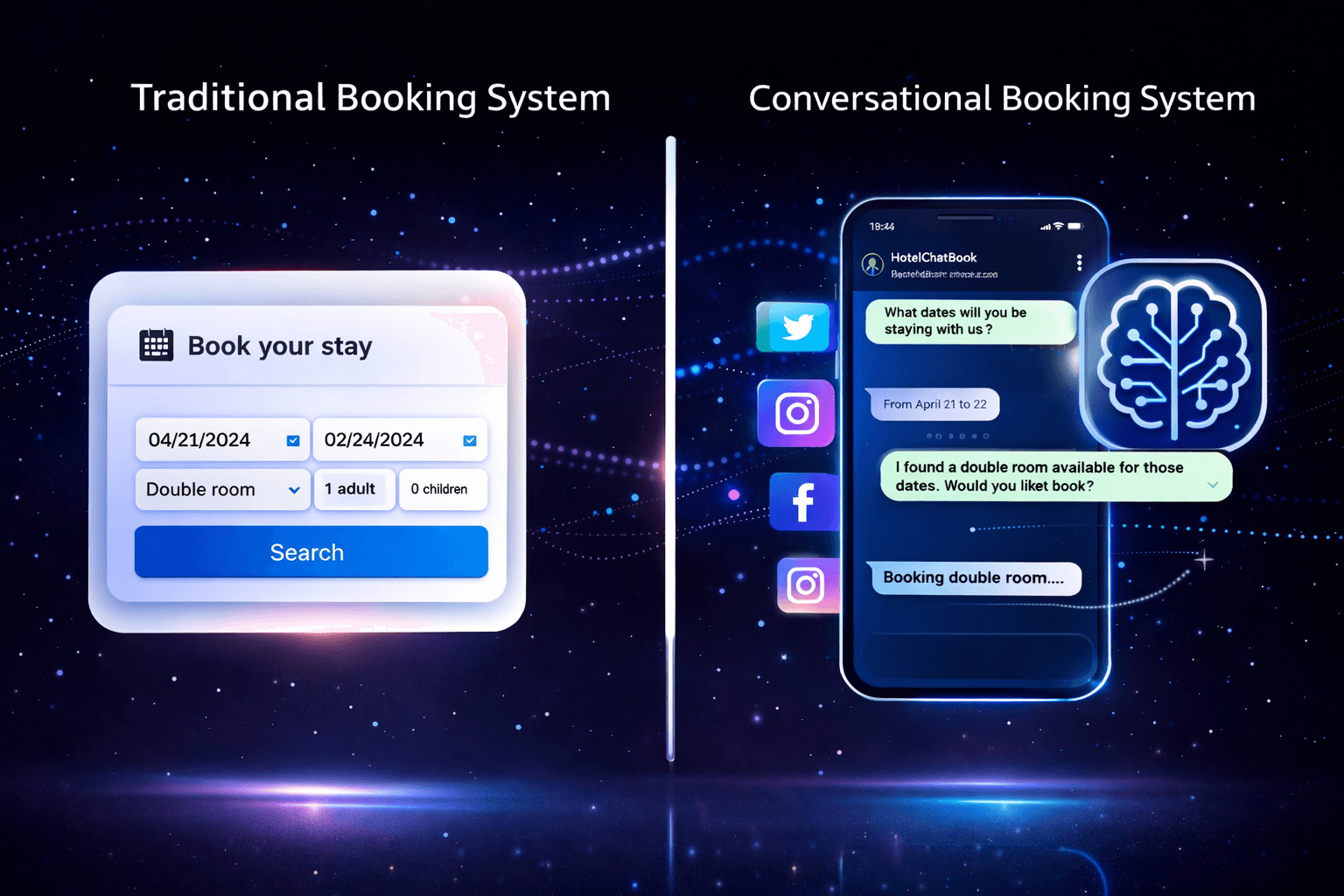
The choice of a booking engine can define the success of a hotel's direct revenue strategy. For years, traditional engines have been the norm, but the advent of artificial intelligence has introduced a new paradigm. Today, the debate centers on the conversational booking engine versus the old static form. But what are the real differences beyond the interface, and how do they impact the metrics that truly matter to a Revenue Manager?
The Era of the Traditional Booking Engine: A Reactive Model
Traditional booking engines function like advanced digital forms. They present users with a calendar, fields for the number of guests, and room types. Their function is purely transactional and reactive: they wait for the user to correctly input all the information to display availability and prices. If a traveler has a specific question, such as "Can I check in at 10 p.m.?" or "Does the rate include breakfast for children?", they must abandon the booking process to find the information on another page or, worse, on another website. This friction is a leading cause of cart abandonment in the hotel industry.
The Quantum Leap: What is a Conversational Booking Engine?
In contrast, a conversational booking engine transforms the process into an interactive and proactive dialogue, similar to what a guest would have with the best front-desk agent. Instead of forcing the user down a rigid path, it allows them to express their needs in natural language. A guest might type, "I'm looking for a room for two adults and a dog from August 15th to 18th in Medellin." The system not only understands the request but instantly responds with available options, confirms the pet policy, and handles the booking within the same conversation. This dynamic approach is fundamental to improving the experience and, as we'll see, the business metrics.
Head-to-Head Comparison: Metrics That Don't Lie
When comparing both models, the data reveals a clear advantage for the conversational approach. The difference isn't just cosmetic; it's directly reflected in the key performance indicators that every revenue manager must monitor. The rise of hotel automation in Colombia is already proving this impact.
Conversion Rate: From Form to Conversation
Conversion rate is perhaps the most critical metric. An average traditional engine converts between 1.5% and 2.5% of the traffic it receives. The process of filling out forms, the lack of immediate answers, and user indecision contribute to this modest figure. A conversational booking engine can lift that rate to 5% or even higher. By resolving doubts in real-time and actively guiding the user toward a purchase, it removes the barriers that cause abandonment. As we explain in our guide on direct booking strategy, reducing friction is key.
ROI in Practice: A Calculation for Revenue Managers
Let's analyze a concrete scenario to understand the return on investment. Imagine a boutique hotel with an ADR (Average Daily Rate) of $150. Its traditional engine converts at 2% on 10,000 monthly visitors, generating 200 bookings ($30,000). By implementing a conversational solution, the conversion rate increases to 4%. With the same traffic, it now generates 400 bookings ($60,000). The $30,000 monthly increase in direct revenue not only covers the cost of the technology but exponentially multiplies the profitability of the direct channel. This is the power of transforming a simple form into an intelligent purchasing experience, much like the concept of a cognitive hotel brain.
Beyond the Booking: Lead Capture and Human Handoff
What about users who aren't ready to book? The traditional engine loses them forever. In contrast, the conversational booking engine is designed to capture interest. If a user asks for unavailable dates, the system can suggest alternatives or register their email to notify them of future offers. Furthermore, it integrates a human handoff system, allowing an agent to step into complex conversations or with high-value guests, ensuring no opportunity is lost.
Conclusion: Which Model Will Scale Your Direct Strategy?
The evidence is clear: while the traditional booking engine serves a basic function, the conversational model represents a strategic evolution. It's not just about adding a chat to your website; it's about integrating an intelligent assistant that sells, assists, and converts 24/7. For Revenue Managers and hotel directors, the decision transcends technology; it's about choosing between a passive model that waits for a sale and a proactive one that creates it. The final question isn't whether you can afford to implement an automated direct channel, but whether you can afford not to.